BestChange in plain English: the exchanger monitor without the marketing
We break down how the BestChange rate aggregator works, how to read the “You give / You get” table, why reserves and reviews matter, and how not to burn money by picking the wrong network. No promotional promises — just what matters before a real exchange.
This is not the official BestChange site best-change.com.ua is an independent educational resource. We are not connected to BestChange, we don't process exchanges and we don't hold your funds. Verify specific figures on the official site.Imagine a dozen exchanger tabs open at once: you manually compare who gives the most hryvnia for your USDT, who has enough reserve, and who can be trusted at all. That is exactly the chore BestChange handles — it collects the rates of hundreds of exchange services into one table and sorts them by value. It is not an exchange or an exchanger: it neither accepts nor holds money. It is a rate directory, a shop window that saves you time and nerves.
The problem is that most articles about this service are either rehashed marketing brochures or SEO filler generated by a bot. We took a different route. This project is an independent audit: we explain the mechanics in plain terms, are honest about the downsides (hidden exchange conditions, verification requirements, a “floating” reserve) and focus on exactly where beginners lose money. Spoiler: most often it's not on the rate, but on a mixed-up transfer network.
Below is the project map: separate breakdowns of BestChange paired with Binance, Monobank, Payoneer, PayPal, EXMO, the NetEx24 exchanger and the P2P format. Further down the page comes the basic theory worth understanding before your first exchange: how a monitor differs from a direct exchange, what custody means, and how to read reserves and reviews.
What an exchanger monitor actually is
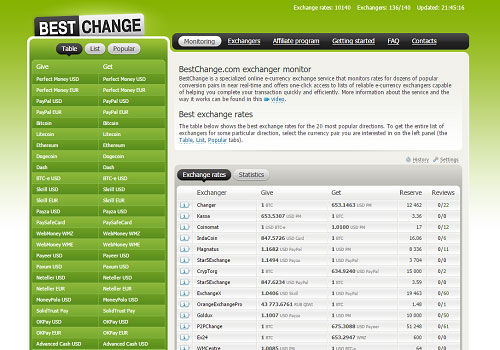
A service like BestChange works as an e-currency rate aggregator. It doesn't buy or sell currency itself — it polls connected exchange offices in real time and arranges their rates into a table for each direction: “Bitcoin → Privat24”, “USDT → cash”, “Perfect Money → Payeer” and hundreds of others. You set what you give and what you want to get, and the monitor instantly sorts the offers from best to worst. In essence, it's a search engine for exchangers — just like a flight aggregator, only for e-currency.
It's important to understand the economics: for you as a user, the monitor is free. It earns from partner payments from exchangers for referred customers, not from a commission on your deal. That means it's in the monitor's interest for the listed exchangers to be alive and to retain users through reviews and fair rates — a bad service quickly loses its position and trust.
Who needs it and when
A monitor is indispensable in three situations. First — when you're cashing crypto into fiat and don't want to give away extra percentages to the first exchanger you find. Second — when you need an exotic direction (say, from one payment system to another) that banks don't support. Third — when speed matters: comparing twenty services by hand is impossible, but the table does it in a second.
Who is it not for? Active traders who already live inside an exchange — it's easier for them to work with orders. And for those who confuse a monitor with a deal guarantor: the aggregator shows rates but is not responsible for how a given exchanger fulfils the request. The choice is your responsibility, and this project is precisely about making that choice an informed one.
The key entities you must distinguish
Crypto literacy begins with precise definitions. Here are four entities beginners constantly mix up: an exchange (Binance, EXMO — a trading venue that holds funds), an exchanger (a fixed-rate exchange service), a payment system (PayPal, Payoneer — a fiat account) and a wallet (where keys are stored, custodial or not). The monitor sits above the exchangers as a shop window. Understanding this hierarchy is half of your safety: you always know who is holding your money at any moment and whom to turn to if something goes wrong.
Five myths about exchanger monitors
Plenty of misconceptions have built up around services like BestChange. Let's dispel the most harmful:
- “The monitor does the exchange.” No. It only shows rates. The exchange happens entirely on the exchanger's side.
- “The top row is always best.” No. The best rate with no reserve or with bad reviews is worse than a second or third option with a solid reputation.
- “If it's listed, it's safe.” Being in the monitor is a starting point, not a guarantee. Read reviews and start small.
- “The rate is fixed until the deal ends.” Not always. Some services recalculate the rate when they receive the crypto; check the fixing terms.
- “The monitor charges me a commission.” No. For users it's free, and the exchange commission is built into the exchanger's rate.
Mini glossary: terms you'll encounter
To read our breakdowns without stumbling, keep a short dictionary handy:
- Reserve — how much currency the exchanger is ready to issue for a direction right now.
- Direction — a “you give → you get” pair, for example “USDT → Monobank UAH”.
- Network (TRC-20, ERC-20, BEP-20) — the blockchain a token transfer runs on; the networks are incompatible.
- Confirmation — the inclusion of a transaction in a block; the exchanger waits for the required number before crediting.
- Custody — who holds the keys: the service (custodial) or you (non-custodial).
- KYC — “know your customer”, the identity verification procedure.
- AML monitoring — a bank's control of suspicious operations and requests for the source of funds.
- Chargeback — a forced reversal of a payment initiated by the payer (relevant for PayPal).
- TXID — the unique transaction hash you can use to find it in a blockchain explorer.
Guides to BestChange products and pairings
Each breakdown is a stress test of a specific direction: where the value is real, where fees are hidden, and at which step people most often slip.
BestChange + Binance
How to withdraw USDT and BTC from the Binance exchange via an exchanger without mixing up the network, and when P2P is better.
Read the breakdownBestChange + Monobank
Exchanging crypto to hryvnia credited to a Monobank card: limits, AML checks and pitfalls.
Read the breakdownBestChange + Payoneer
Topping up and withdrawing Payoneer via exchangers: rates, verification and freeze risks.
Read the breakdownBestChange and P2P exchange
How a monitor differs from P2P on an exchange, what escrow is, and how to avoid “dirty” money.
Read the breakdownBestChange + PayPal
Why PayPal is the most temperamental direction, chargebacks, and how exchangers protect themselves from reversals.
Read the breakdownBestChange + EXMO
Deposits and withdrawals via the EXMO exchange: fiat, fees, verification and what to weigh in the monitor.
Read the breakdownBestChange and NetEx24
A breakdown of one exchanger from the monitor list: how to read its card, reserve and reviews.
Read the breakdownA monitor, an exchanger, an exchange and a wallet are four different things
Before you exchange anything, understand which participant holds your money and whom to go to if something goes wrong.
Custodial services (you don't hold the keys)
An exchange (Binance, EXMO) and an exchanger are like a bank: while the funds are with them, they control access. Convenient, but you depend on their rules, verification (KYC) and freeze decisions.
Non-custodial wallet (you hold the keys)
MetaMask, Trust Wallet — this is your personal safe. Full control, but also full responsibility: if you lose the seed phrase, no support that “resets the password” exists.
Exchanger monitor vs blind direct exchange
Why checking rates through an aggregator is almost always better than walking into the first exchanger you find.
| Criterion | First exchanger you find | Through a rate monitor |
|---|---|---|
| Exchange rate | Whatever it is — nothing to compare | You see the best of dozens of offers |
| Reserve (is there enough currency) | You find out only when placing the request | Shown in advance, before you go |
| Service reputation | On trust | Reviews and rating next to the rate |
| Hidden fees | Often surface at the end | Easier to spot when comparing |
| Search time | 10+ open tabs | One table, a couple of clicks |
| Cost to you | 0 ₴, but higher overpayment risk | 0 ₴, lower overpayment risk |
The table describes the approach in general; always verify specific rates, reserves and ratings on the official site bestchange.com before exchanging.
Exchange through a monitor in 4 steps
The logic is the same for any direction — from “USDT → hryvnia to Monobank” to “Payoneer → crypto”.
Choose a direction
On the left — what you give (say, USDT TRC-20), on the right — what you want to get (hryvnia to a card, PayPal, cash).
Compare the rows
The table is sorted by value. Look not only at the top rate, but also at the reserve and the number of reviews.
Go to the exchanger
One click takes you to the chosen service's site. The exchange happens there — the monitor takes no part in the deal.
Check details and network
On the exchanger's side, verify the rate, the amount you'll receive and — critically — the transfer network before sending anything.
The most expensive beginner mistake is sending, say, USDT on the ERC-20 network to an address that only accepts TRC-20. The coins go “nowhere”, and recovering them is nearly impossible. Always verify the network (TRC-20, ERC-20, BEP-20) on both sides of the transfer. The rate is secondary; the network is primary.